
Why Getting Your Bra Size Right Actually Matters
A bra is the most worn — and most frequently mis-sized — piece of clothing most women own. This isn’t a minor style issue. Research consistently links poorly fitted bras to back, neck, and shoulder pain, restricted movement during exercise, skin irritation, and reduced confidence in daily life.
How common is the problem? Estimates vary depending on how “wrong size” is defined and measured, which is worth being upfront about rather than repeating an inflated number. A frequently cited academic study published in the Journal of Bodywork and Movement Therapies found that among a sample of young women, roughly 80% wore an incorrectly sized bra — 70% too small, 10% too large. A separate 2025 analysis of bra fit quality found an even higher figure of 93% wearing the wrong size, with the most common error being a band that’s too loose paired with a cup that’s too small. Clinical teams at NHS trusts in the UK, including Frimley Health NHS Foundation Trust, cite a similar figure of roughly 8 in 10 women.
The exact percentage matters less than the consistent pattern across all this research: most women are not wearing their correct size, and the most common mistake is the same one — an oversized band and an undersized cup.
This guide walks through exactly how to measure yourself, how the calculation works, what your size means across different countries’ sizing systems, and when a bra fit issue might be worth mentioning to a healthcare provider. A working calculator that applies everything below is available at the top of this page.
What a Bra Size Calculator Actually Does
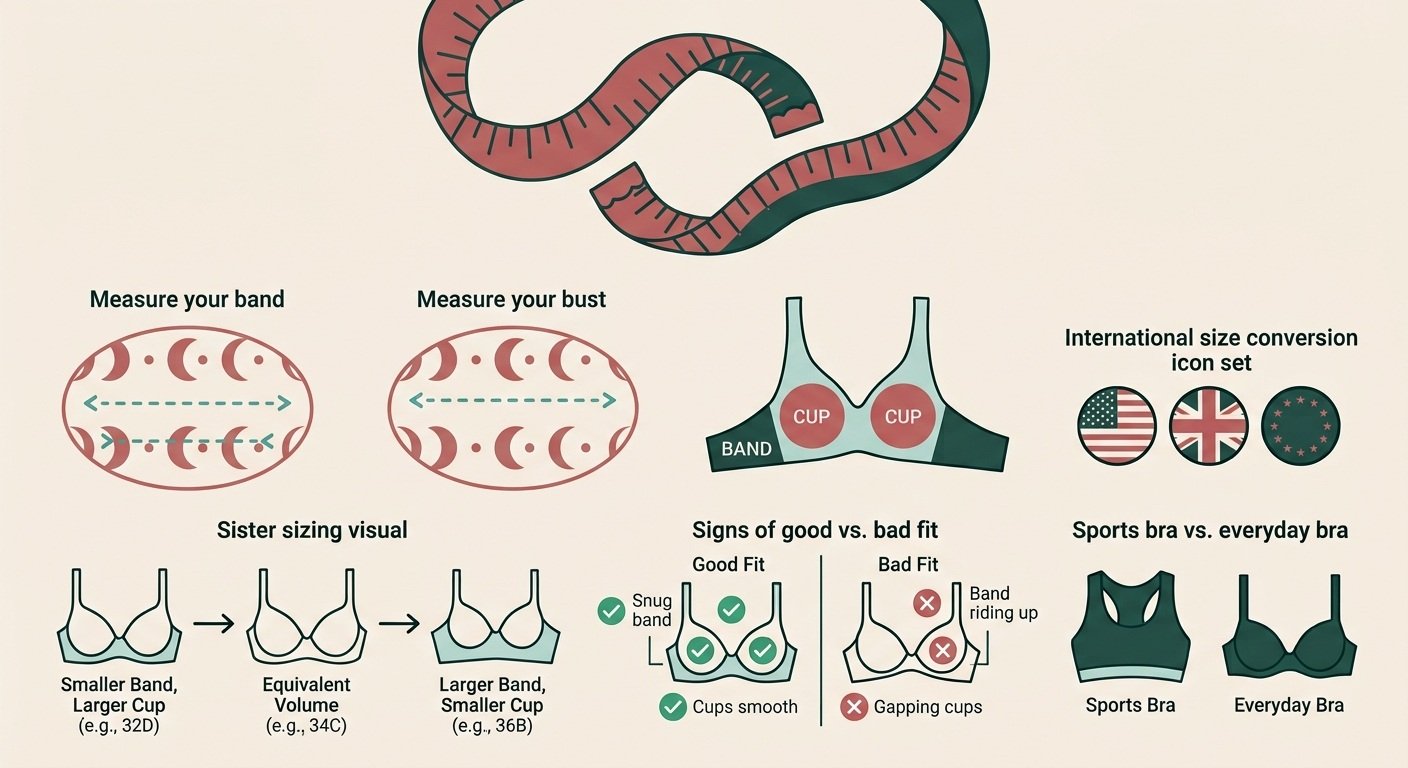
A bra size calculator takes two simple measurements — your band (underbust) and your bust (fullest point) — and converts the difference between them into a standard size, expressed as a number (band) and a letter (cup). It’s a starting point, not a guarantee, because bra sizing is not standardized between manufacturers. Two different brands’ 34C bras can fit noticeably differently. Even so, a calculated estimate gets you dramatically closer than guessing, and gives you a consistent number to work from when trying bras on.
Band Size vs. Cup Size: What the Numbers Actually Mean
- Band size (the number, e.g. 34) describes the circumference of the bra around your ribcage, directly under your bust. This band does the majority of the supportive work — not the straps.
- Cup size (the letter, e.g. C) describes the volume of the cup relative to your band size. Importantly, a cup letter is not a fixed size — a C cup on a 32 band holds less volume than a C cup on a 38 band. Cup size is always relative to band size, which is why “big” or “small” cup letters can be misleading out of context.
How to Measure Your Bra Size at Home: Step-by-Step
You’ll need a soft, flexible measuring tape (not a stiff metal one) and, ideally, a well-fitting, non-padded bra to measure in.
Step 1 — Measure Your Band (Underbust)
Wrap the tape snugly around your ribcage, directly beneath your bust, keeping it level all the way around your back. It should feel firm but not compress your ribs — you should be able to breathe normally. Round to the nearest whole number.
Step 2 — Measure Your Bust (Fullest Point)
Wrap the tape around the fullest part of your bust, keeping it parallel to the floor and not pulled tight. Breathe normally and let the tape sit naturally.
Step 3 — Calculate the Difference
Subtract your band measurement from your bust measurement. This difference, in inches, corresponds to a cup letter:
| Bust − Band Difference (inches) | US / Pakistan Cup | UK / AU Cup |
|---|---|---|
| Less than 1 | AA | AA |
| 1 | A | A |
| 2 | B | B |
| 3 | C | C |
| 4 | D | D |
| 5 | DD / E | DD |
| 6 | DDD / F | E |
| 7 | G | F |
| 8 | H | FF |
Worked example: Underbust = 75cm (≈ band 32), Bust = 90cm. Difference ≈ 15cm, or about 6 inches — landing at roughly a 32DDD/F (US) or 32E (UK).
International Bra Size Conversion Chart
Because there is no single global sizing standard, the same physical size carries different labels depending on the country. This is one of the most common sources of confusion when shopping from international or online retailers.
| Band (US/UK) | Band (EU) | Band (FR/BE/ES) | Cup A | Cup B | Cup C | Cup D | Cup DD/E |
|---|---|---|---|---|---|---|---|
| 30 | 65 | 80 | 30A | 30B | 30C | 30D | 30E |
| 32 | 70 | 85 | 32A | 32B | 32C | 32D | 32E |
| 34 | 75 | 90 | 34A | 34B | 34C | 34D | 34E |
| 36 | 80 | 95 | 36A | 36B | 36C | 36D | 36E |
| 38 | 85 | 100 | 38A | 38B | 38C | 38D | 38E |
| 40 | 90 | 105 | 40A | 40B | 40C | 40D | 40E |
Pakistan does not have its own standardized bra sizing system — most retailers follow either the US/UK numbering or import EU-labelled stock, so it’s worth checking a brand’s specific size chart rather than assuming a 34B means the same thing everywhere.
Bra Sister Sizing Explained
If your calculated size isn’t available, doesn’t fit quite right, or a specific style runs differently, a “sister size” is a same-cup-volume alternative in a different band/cup combination.
- Sister size up (larger band, same feel): go up one band size and down one cup letter — e.g. 34C → 36B
- Sister size down (smaller band, same feel): go down one band size and up one cup letter — e.g. 34C → 32D
Sister sizes hold roughly the same cup volume but change how the band and straps carry that support, so it’s a useful trick when a size is out of stock or when a particular style feels wrong despite the number technically matching your measurements.
Special Cases: When Standard Sizing Isn’t Enough
Sports Bras
Sports bra fit deserves its own attention, and there is a substantial body of research behind why. The University of Portsmouth’s Research Group in Breast Health — the world’s leading academic centre for breast biomechanics — has tested over 700 sports bras on more than 8,000 women. Their research found that in a survey of UK female athletes, 51% experienced breast pain during activity, and 29% said poorly fitting sports bras affected their performance. When elite athletes were properly fitted ahead of the Tokyo Olympics, 97% reported improved comfort and support, and 17% reported a measurable improvement in performance.
The practical takeaway: your everyday bra size is a starting point for a sports bra, not the final answer — sports bras are fitted for compression and reduced movement, and sizing between brands varies even more than with everyday bras.
Maternity and Nursing Bras
Breast size can change significantly and repeatedly during pregnancy and breastfeeding — often several band and cup sizes across pregnancy, birth, and the return of milk supply. Because of this, it’s worth re-measuring every trimester and again after birth, rather than assuming your pre-pregnancy size still applies.
Larger Cup Sizes and Chronic Back Pain
A 2023 clinical study published in Prosthetics and Orthotics International investigated whether alternative breast support garments could relieve chronic non-specific back pain in larger-breasted women, noting that ill-fitting bras are a recognized contributor to this kind of pain and that correctly fitted support is a recommended non-surgical management step. If back pain persists despite a properly fitted bra, this is a reasonable thing to raise with a healthcare provider rather than something to push through indefinitely.
Signs You’re Wearing the Wrong Bra Size
| ✅ Signs of a good fit | ❌ Signs it doesn’t fit |
|---|---|
| Band sits level, doesn’t ride up your back | Band digs in or leaves red marks |
| Two fingers fit snugly under the band | Straps dig into shoulders or slip off |
| Straps stay in place without tightening constantly | Center of bra doesn’t sit flat against your chest |
| Cups fully contain your bust, no gaping or spilling | Bust spills over the top or sides of the cup |
NHS patient guidance (Leeds Teaching Hospitals NHS Trust) notes that a well-fitting bra is one of the practical self-management steps recommended for breast pain (mastalgia), alongside identifying whether a supportive style — such as a sports-style bra — reduces discomfort.
How Often Should You Re-measure?
As a general guide, re-check your size every 6–12 months, and sooner after any of the following:
- Noticeable weight gain or loss
- Pregnancy or breastfeeding, at each stage
- Starting or stopping certain medications or hormonal contraception
- Perimenopause or menopause
- If an old favorite bra suddenly feels different — elastic naturally loses its stretch over time, even without your body changing
Common Bra Fit Problems, Troubleshooted
Straps keep falling down — Usually means the band is too big, so the bra rides up and the straps lose their angle. Try a smaller band with a larger cup (a sister size).
Band rides up your back — Almost always a too-loose band. The band should stay level and horizontal, not ride up toward your shoulder blades.
Underwire digs in or pokes out at the sides — Usually a cup that’s too small; try going up a cup size while keeping the same band.
Bra feels fine sitting but uncomfortable moving/exercising — A correctly sized everyday bra may still be the wrong choice for activity; consider a dedicated, properly fitted sports bra.
A Note on Breast Self-Awareness
Since a bra fitting already involves measuring and paying attention to your breasts, it’s a natural moment to build a habit of general breast self-awareness — simply knowing what’s normal for you, so you’d notice a genuine change. A WHO memorandum on breast self-examination notes that while self-examination alone hasn’t been proven to reduce mortality on its own, awareness and self-familiarity remain a reasonable, low-cost part of overall breast health, particularly where regular clinical screening isn’t easily accessible.
This is especially relevant in Pakistan: published research on breast self-examination among Pakistani women has found that cultural stigma and discomfort discussing the topic are significant barriers to awareness and early detection — which is exactly the kind of silence a private, judgment-free space can help work against.
This is general educational information, not medical advice. If you notice a lump, persistent pain, or any change in your breasts, speak with a doctor.
Frequently Asked Questions
How accurate is a bra size calculator?
It’s a reliable starting point based on your measurements, but not a guarantee — sizing isn’t standardized across brands, so treat the result as your size to try first, not a final answer.
What’s the difference between band size and cup size?
Band size is the measurement around your ribcage and provides most of the bra’s support. Cup size describes the volume of the cup and is always relative to the band — the same letter means different things on different bands.
How do I find my bra size without a measuring tape?
A piece of string and a ruler can substitute for a soft tape in a pinch — measure with the string, then lay it against the ruler. A proper soft tape measure is still the more accurate and comfortable option.
What if I fall between two sizes?
Size up rather than down, or try your sister size — the same cup volume in a different band/cup combination.
Why does my bra size seem to change throughout the month?
Hormonal fluctuations across the menstrual cycle can cause temporary changes in breast size and tenderness, which is normal and doesn’t necessarily mean your baseline size has changed.
Is a sports bra size the same as my regular bra size?
Not necessarily. Sports bras are built for compression and reduced movement, and research from breast biomechanics specialists shows sizing and fit needs differ meaningfully from everyday bras, especially for higher-impact activity.
How often should I get remeasured?
Every 6–12 months as a general rule, and sooner after weight changes, pregnancy, breastfeeding, or a hormonal shift like starting menopause.
Can a wrong bra size actually cause pain?
Yes — an ill-fitting bra, particularly a loose band paired with a tight strap or small cup, is a recognized contributor to back, neck, and shoulder discomfort, and NHS guidance lists a well-fitting bra as a self-management step for breast pain.
References and Further Reading
- Wood, K. et al. “Breast size, bra fit and thoracic pain in young women: a correlational study.” Journal of Bodywork and Movement Therapies — ncbi.nlm.nih.gov/pmc/articles/PMC2275741
- “Highlighting the need for change through an analysis of bra fit quality.” Taylor & Francis Online, 2025 — tandfonline.com/doi/full/10.1080/17543266.2025.2461460
- Frimley Health NHS Foundation Trust — “Bra Measurement” patient guidance — fhft.nhs.uk
- Leeds Teaching Hospitals NHS Trust — “Breast Pain (Mastalgia)” patient information — flipbooks.leedsth.nhs.uk
- University of Portsmouth, Research Group in Breast Health — sports bra and performance research — port.ac.uk
- Haworth, L. et al. “Does an alternative breast support garment provide symptomatic relief for larger breasted women with chronic non-specific back pain?” Prosthetics and Orthotics International, 2023 — pmc.ncbi.nlm.nih.gov/articles/PMC11005674
- World Health Organization — “Self-examination in the early detection of breast cancer: Memorandum from a WHO Meeting” — pmc.ncbi.nlm.nih.gov/articles/PMC2536257
- “Breast Health Education as a Motivator for Breast Self-Examination Practice in High-Risk Women” (includes Pakistan-specific cultural findings) — ncbi.nlm.nih.gov/pmc/articles/PMC12798839